
Bulletproof.
For About 5 Mins.

A lot of us get these waves of confidence after a good meeting, a productive day at home (tough to beat lording it up on the sofa in a tidy home after completing all your adult chores), completing something hard, or just finishing the day knowing you really did something of value. You log off or walk back in through the door with your head a little higher than normal. With your chin up as high as Boysie from ‘Only Fools and Horses’, giving off a whiff of “today world, I won.”
And so you f**king should.
There’s about five minutes where you feel unstoppable.
Everything went your way. Confidence is high, chest is out, there’s a little funk to your stride like you’ve got your own Bruno Mars soundtrack. Maybe the ego has blossomed a touch. For those five minutes, you feel absolutely bulletproof.
Then that little window of internal gloating slams shut and it dawns on you that you forgot to put the bins out and you’ve just walked mud through the house. It wasn’t long but you’re brought straight back down to your regular, fallible, human self. Immediately regulated by the universe, so you don’t start getting above your station for too long.
But before we get back to normalcy and the authenticity of being unoptimised, which is a space I am playing in a lot at the moment (more on that another day), that ‘you’re on fire’ irregular five minutes when everything’s gone bang on, is an invitation to double down on your courage while your confidence is abnormally through the roof.
The dog walk that sparked it
A few years back, before the books, before the TEDx, before the podcasts, my regular 9–5 was plodding along and I was just getting started with the writing and speaking. After a decent day at work and some nice words from a few C-suite colleagues, I was on cloud nine.
Out walking my dog Daisy (miss you, mate), I had the full beautiful mix.
Internal confidence from knowing I’d done something well
External validation from people I respected
Fresh air and movement
My favourite pooch trotting along beside me
A few minutes wandering round Beckenham Place Park and I felt like I could do anything. Nodding and smiling at other dog walkers, chatting to neighbours, generally bowling round like I’d just won the lottery.
Not that I know what that is like. What is that like?
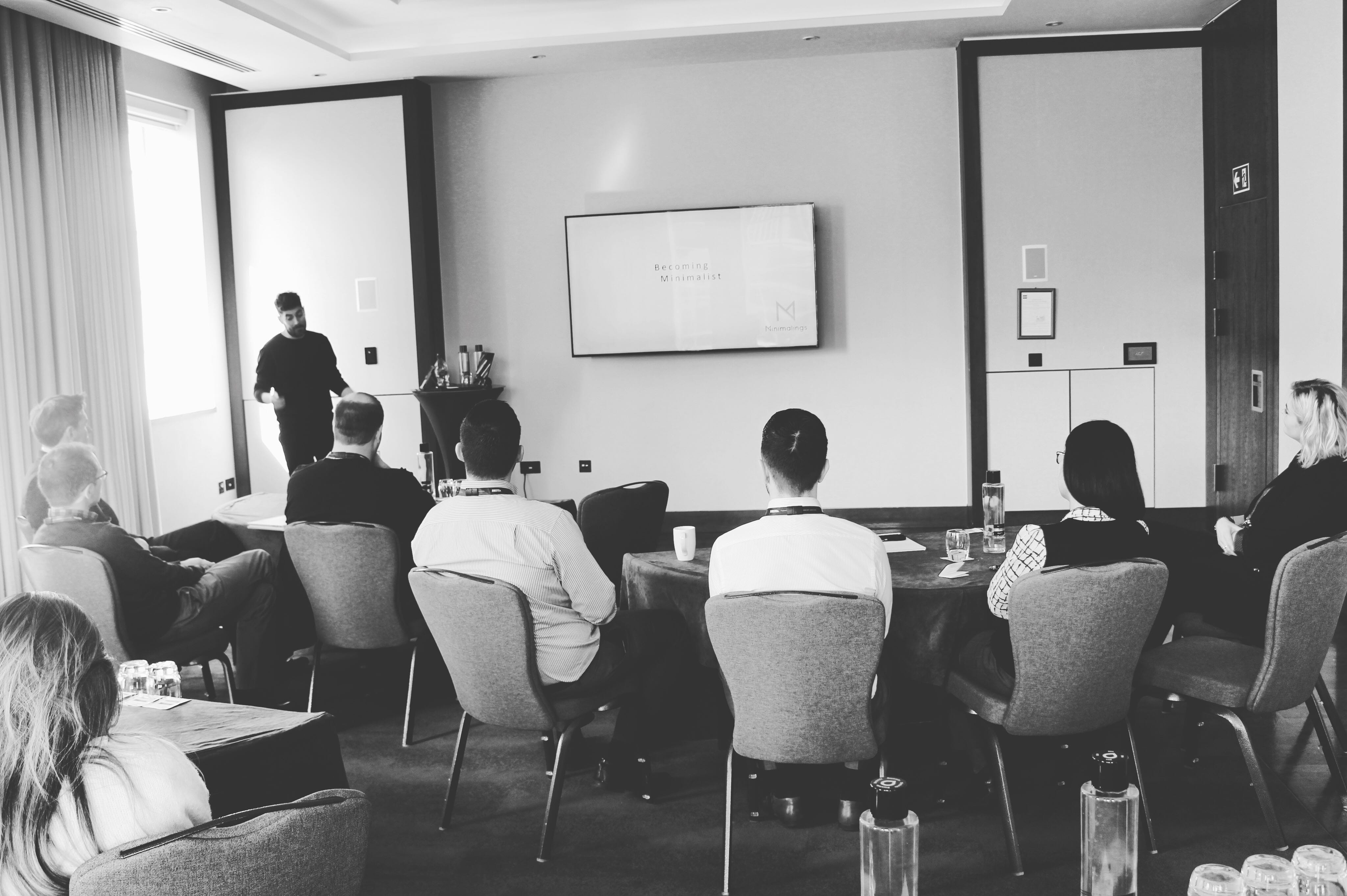
That’s when the idea landed. Could I use Beckenham Place Park’s Georgian Mansion to host a talk on decluttering and minimalism? I’d seen them run other events there, yoga, life drawing (saucy), so I figured I’d just ask for a room, for free, because in that moment I felt like I couldn’t lose. Brave enough to just ask for what I wanted. That’s harder for most of us than you’d think.
So in those five minutes of feeling bulletproof, I fired off one email. One cheeky ask. And then life resumed to it’s normalcy and I forgot about it completely.
Two weeks later, a reply: yes, come and do your talk, and we’ve already got a staff member sorted to help with setting everything up.
By the time that response had landed, the funky walk and Boysie chin had long been forgotten. It was back to having a regular chin and normal person walking. Not so bulletproof anymore.
Now I actually had to go and do the thing. Ahh f**king hell.
I’d pushed the boundary while I was confident, asked a question I’d normally have been too nervous to ask, then promptly forgot I’d asked it. Turns out that was exactly the shove I needed into the space I needed to be in.
And yes, there’s research behind why this works.
In 1972, two psychologists, Alice Isen and Paula Levin, ran one of the most quietly brilliant experiments in social psychology. In San Francisco and Philadelphia, they planted a dime in the coin return slot of public phone boxes, then watched what happened to whoever found it.
Moments after each call ended, a researcher “accidentally” dropped a stack of papers right in front of the caller. Clumsy fool. People who hadn’t found the dime mostly walked past. People who had found it stopped and helped twenty-two times more often.
TWENTY-TWO TIMES.
From a single dime.
The dime didn’t make anyone richer, more capable, or better equipped to help. It changed nothing practical about their personal situation whatsoever. What it changed was their internal state, for a few minutes, and that brief lift was enough to flip a stranger from “not my problem bruv” to “let me get that for you.”
A tiny, fleeting boost in how someone felt about themselves directly changed what they were willing to do next.
Isen later ran a version of this on people who actually had something at stake. In a 1991 study, medical students who’d just had a small win, solving an easy word puzzle, were asked to diagnose a set of tricky lung cases. They reached their decisions faster than students who hadn’t had the win, and they were more likely to go beyond what was asked of them, digging into the other patients’ cases off their own back, unprompted.
This isn’t a “I feel good, lets bet the house on Curacao winning the World Cup” free pass, it’s more specifically a green light for action, for doing the thing, asking the thing, offering the thing you’d normally talk yourself out of.
Which is exactly what happened in that phone box. And on that dog walk in Beckenham.
The cost of not asking
The other half of this isn’t just the quick hit of confidence, it’s what you do with it. And the thing most of us do with a five-minute window of gloat and courage is relax back in our chair, look at ourselves in the mirror for a bit or absolutely nothing, because asking for things is uncomfortable.
Author Jia Jiang found this out the hard way which he shares in his TED talk. After a failed startup pitch left him in a spiral of self-doubt (we’ve all been here), he set himself a challenge to go and get rejected, on purpose, every day for 100 days. Ask a stranger to borrow £100. Ask a fast food worker for a free “burger refill” (brilliant, may try this myself). Ask a Krispy Kreme manager to make doughnuts shaped like Olympic rings (she did, for free, and the video has had five million views).
By the end of the 100 days, half of his “ridiculous” requests had actually been accepted. His takeaway, and it’s a good one: “All you want is to stay comfortable and have the possibility of future success when you have the courage to ask. But often we don’t ask.” Most people, he found, genuinely want to say yes, the job of the person asking is just to make it easy for them to do it.
That’s basically what happened with the Mansion. I didn’t have a watertight pitch. I didn’t have a marketing plan. I had one email, sent in a five-minute window where I had nothing to lose because I felt, briefly, untouchable.
What to actually do with your bulletproof five minutes
Not every bulletproof window needs to end in a TEDx talk or a Georgian Mansion though, don’t worry. But here’s roughly the shape of it:
Notice it. That’s most of the battle. The walk with your chin up (Boysie or not, your choice), the little swagger, just clock it when it’s happening, not three days later.
Make one ask or do a slightly braver thing while it’s live. Not five. One. The email, the message, applying for that job, asking for a chat with someone, asking for a payrise, the “can I run this idea past you”, your first ever newsletter, send it, do it, before the feeling fades.
Then let it go. Forget about it, like I did. Five minutes is the dose. Stretch it into five days of strutting round thinking you’re untouchable and you tip from confident into an insufferable little sh!t and nobody wants to work with that version of you, including future you.
Now, I caveat here that not everyone wants on needs to keep pushing, for some people, just having a good day and acknowledging that fact is more than enough. And I encourage you to do just that.
But for others, sometimes the bins wont go out on time, sometimes you’ll walk mud on the carpet, but sometimes, you’ll feel like an absolute hero. When (not if) that happens, it could just be the window your braver self was looking for. Burger refills for the win anyone?
If you haven’t got your copy of Relentless: The Power of Doing Less in a Workplace that Demands More yet, you can get it here. Now available at wherever you buy books.
Plus, if you want some copies for your team, my publisher is doing, quite frankly, an incredibly generous discount for my friends, so drop me a line and I’ll sort you out.
💪 Want To Work With Me?
There are several ways we can collaborate:
And there are several ways your employer can cover the cost!
Have me speak at your next event or conference
Bring me in for workshop sessions with your team, leaders or employees
Sponsor my newsletter
Article / Blog Contributions
1-1, group or team coaching
If you’re interested in any of these opportunities, please drop me an email at chris@chrislovett.co.uk or DM me on Linkedin / Instagram / Substack